• Don’t Let Him In — Book Review **SPOILERS**

    Part One opens and closes with Paddy, a man described as the life of the party, the kind of person who lights up a room the moment he walks in. Naturally, that means he ends up brutally murdered (pushed under a train). At this point I’m convinced being universally loved in thrillers is basically a death sentence.

    By Part Two I was already hooked. The pacing pulls you in quickly, and the rotating perspectives kept the tension building. We follow Ash and her mother Nina in the aftermath of Paddy’s death, while chapters from the past slowly unravel the truth about the man moving into their lives.

    Ash’s insecurity about being 26 and still living at home hit a little too close to home for me. That whole feeling of “falling backward” while everyone else seems to be moving forward is painfully relatable, and it made her perspective feel very grounded.

    Nina moving on with Nick so soon after Paddy’s death definitely raised some alarms. But at the same time, seeing Ash notice that the “light” had returned to her mother’s eyes made the situation complicated. Shared grief can create strong bonds between people; though in this case, Nick’s claim that he had lost someone too felt suspicious from the beginning.

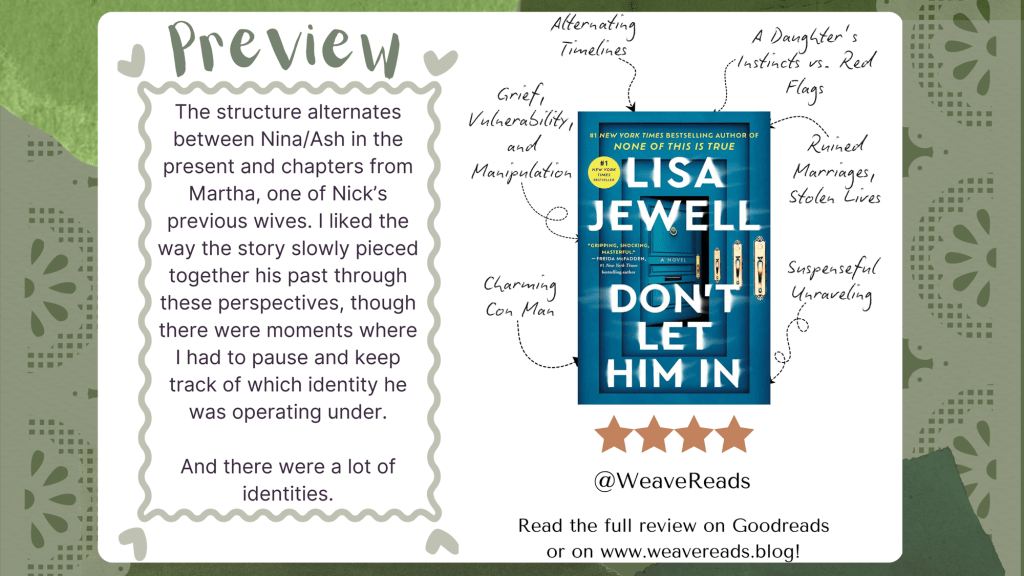
    The structure alternates between Nina/Ash in the present and chapters from Martha, one of Nick’s previous wives. I liked the way the story slowly pieced together his past through these perspectives, though there were moments where I had to pause and keep track of which identity he was operating under.

    And there were a LOT of identities.

    Nick — also known as Simon, Al, and several other names — had a whole trail of destruction behind him: a first wife Amanda and two sons, then Tara, Laura, and Martha, each relationship ending with manipulation, financial ruin, or worse. Watching the layers of his lies unravel was honestly one of the most satisfying parts of the book.

    Some plot elements stretched my suspension of disbelief a bit. The explanation behind Paddy’s murder — the “Silver Man” telling someone to push him onto the tracks — felt a little convenient, especially when the police seemed willing to dismiss it so quickly. Law enforcement overlooking the many red flags surrounding Nick also became a bit frustrating.

    Still, the tension of watching his carefully constructed life start to collapse was compelling.

    By the end, Nick’s web of lies finally catches up to him. Personally, I would have loved a more concrete sense of justice. Knowing he was about to be arrested didn’t feel entirely satisfying to me. This is a man who had slipped through consequences his entire life, so l kept waiting for one last twist where he somehow escaped again.

    Overall, Don’t Let Him In was a really engaging thriller with a strong central antagonist and an addictive structure. Even when a few plot points felt unlikely, the steady unraveling of Nick’s past kept me turning the pages.

    Final Rating: 3.5 stars, rounded up to 4.

  • The Thursday Murder Club — Book Review

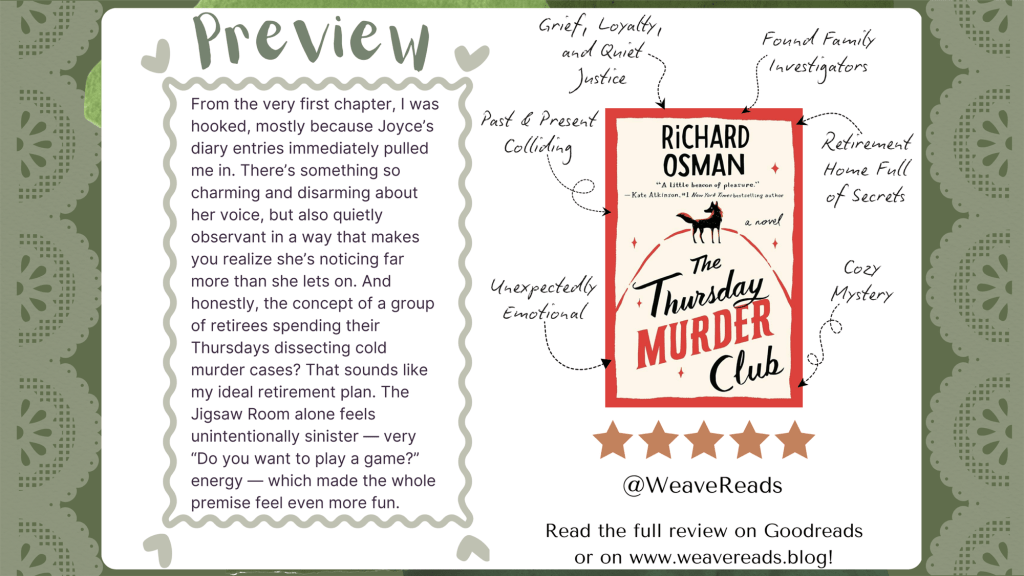
    From the very first chapter, I was hooked, mostly because Joyce’s diary entries immediately pulled me in. There’s something so charming and disarming about her voice, but also quietly observant in a way that makes you realize she’s noticing far more than she lets on. And honestly, the concept of a group of retirees spending their Thursdays dissecting cold murder cases? That sounds like my ideal retirement plan. The Jigsaw Room alone feels unintentionally sinister — very “Do you want to play a game?” energy — which made the whole premise feel even more fun.

    One of my favorite aspects of this story is how often the older residents are underestimated. Society tends to write people off as they age, assuming they’re forgetful, harmless, or uninvolved; this book completely dismantles that assumption. Elizabeth, Joyce, Ron, and Ibrahim are constantly observing, connecting dots, and quietly staying several steps ahead of everyone else, including the police. There’s something incredibly satisfying about watching them use that invisibility to their advantage. They aren’t just solving a mystery, they’re reclaiming agency in a world that assumes they’ve lost it.

    The found-family dynamic between the Murder Club members was easily one of the strongest emotional cores of the story. Their loyalty to one another, their quiet protectiveness, and the way they show up for each other — even when things get dangerous or painful — made the mystery feel grounded in something much deeper than just a “whodunit.” The relationships, especially Elizabeth’s devotion to Penny and Joyce’s growing confidence and sense of purpose, added so much emotional weight.

    And the mystery itself genuinely surprised me. Every time I thought I had a clear suspect or understood what was happening, the narrative shifted just enough to make me question everything again. New layers of the past slowly surfaced, secrets intertwined, and what initially seemed like a straightforward murder unraveled into something far more complex and human. Nothing felt cheap or random. Every reveal added meaning to what came before it.

    What surprised me most was how well the alternating perspectives worked. Normally that structure can feel disjointed, but here it made the world feel interconnected. Each character offered a piece of the larger puzzle, and together they formed a complete picture: one built on memory, grief, justice, and loyalty.

    Ultimately, this wasn’t just a murder mystery. It was a story about aging, friendship, loss, and the quiet strength people carry with them long after the world stops paying attention. It balanced humor, heart, and suspense beautifully, and I found myself completely invested in these characters.

    I loved this story. It was clever, heartfelt, and genuinely unique — and I already miss spending time with the Murder Club.

  • The Strange Case of Dr. Jekyll and Mr. Hyde — Book Review **SPOILERS**

    There’s no subtlety whatsoever in how Hyde is introduced — he tramples a literal child within minutes of appearing, which is honestly such an insane opening move that it immediately sets the tone. Stevenson wanted you to distrust him, to hate him, and it works. But what fascinated me more was how much of that hatred seemed tied to Hyde’s appearance. Everyone describes him as wrong, unsettling, impossible to look at — but rarely explains why. It makes you wonder how much of Hyde’s monstrosity is inherent, and how much of it is perception.

    First of all, “If he be Mr. Hyde, I shall be Mr. Seek.” Absolutely brilliant line. No notes. Utterson immediately positioning himself as the one who will uncover the truth makes the mystery feel deliberate, like we’re watching someone slowly pull on a thread that’s been waiting to unravel.

    I’ll admit, I struggled at times keeping track of everyone when they’re all just “Mr. Something.” Please. First names. Nicknames. Anything. But the moment where Hyde’s handwriting is discovered to be the same as Jekyll’s, just slanted differently, was incredible. Those are the kinds of reveals I live for, especially because it wasn’t some grand authority figure who noticed, but a clerk. A servant. Someone easily overlooked. It makes the discovery feel more grounded and real.

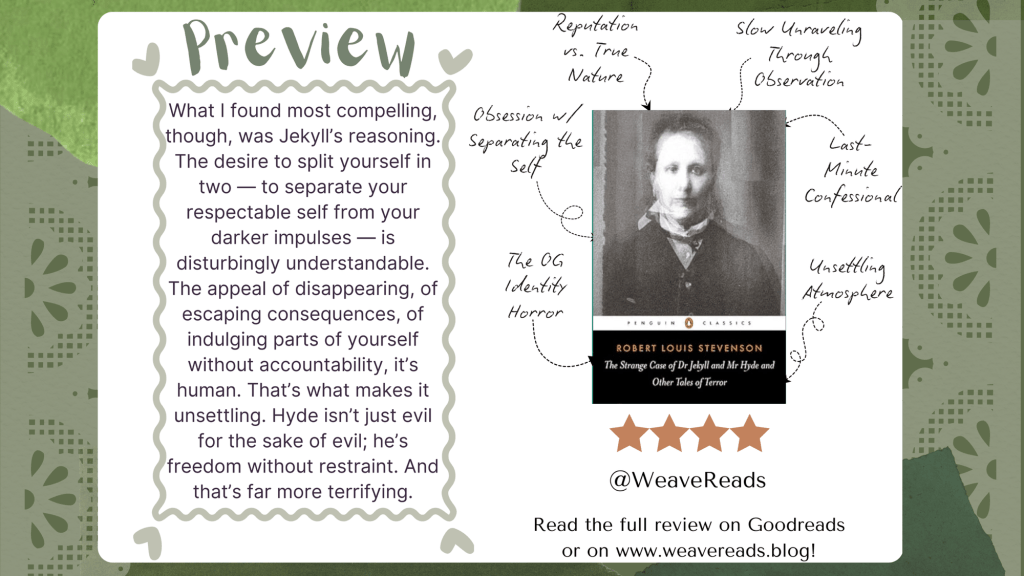
    What I found most compelling, though, was Jekyll’s reasoning. The desire to split yourself in two — to separate your respectable self from your darker impulses — is disturbingly understandable. The appeal of disappearing, of escaping consequences, of indulging parts of yourself without accountability, it’s human. That’s what makes it unsettling. Hyde isn’t just evil for the sake of evil; he’s freedom without restraint. And that’s far more terrifying.

    I loved ending on Jekyll’s confession. I’m always a sucker for letter reveals, and getting his perspective reframed everything that came before it. You finally see the cost of what he thought he could control.

    I’m giving it 4 stars. I genuinely enjoyed it, but it almost feels like a glimpse of something larger rather than the full story. If it had gone deeper — spent more time exploring Jekyll’s internal conflict, or Hyde’s growing influence — I think it would’ve been something I’d revisit again and again. As it is, it’s powerful, iconic, and fascinating, but it leaves you wishing for just a little more.

  • Dear Debbie — Review **SPOILERS**

    Frieda McFadden’s novels are always a mixed bag for me. Just using her author’s note as an example, I appreciate that she makes her books accessible and includes a full list of trigger warnings, but the tone she uses sometimes just doesn’t land for me personally. There’s a certain playful, almost overly sanitized way she frames things, like spelling out “S-E-X” as if to keep things feeling intentionally PG, and it pulls me out of the experience a bit. I get that it’s meant to be tongue-in-cheek, but it just doesn’t match the darker themes the story is actually exploring.

    That disconnect kind of carries over into the characters too. Frieda’s characters always feel heightened, but here especially, everyone feels turned up to eleven. Lexi is teenagery in the most exaggerated, snark-at-every-turn way, and the dialogue between her and Debbie didn’t feel natural to me. There were multiple moments where people said things that no one would realistically say out loud, including one of those cringey “and then everybody clapped” type scenes that completely broke the immersion. Even some of the plot reveals — like the rumors about Debbie’s daughter’s coach — felt like information that realistically would have surfaced much earlier, especially if multiple girls were involved.

    But where the book started to hook me was with Debbie herself.

    The “Dear Debbie” drafts were easily one of the more interesting parts of the story. Watching her casually suggesting things like kidnapping and eardrum mutilation was unsettling in the best way, because it hinted at something darker beneath the surface of this mild-mannered suburban mom everyone underestimated. And that’s really the heart of the story: Debbie isn’t just snapping out of nowhere. She’s someone who is clearly intelligent, capable, and creative. She went to college and designed phone applications. She had ambition. But over time, she was flattened into a role that made her invisible. A housewife, a mother. Someone easy to dismiss.

    And everyone did dismiss her.

    Her husband, her friends, her children, the other housewives around her — they all viewed her through this narrow, outdated lens of what a “mild-mannered housewife” is supposed to be. There’s this constant undercurrent of misogyny in her world, where she’s talked down to, underestimated, and quietly devalued. It honestly made it hard not to root for her, even as she started doing objectively awful things. When she poisoned the book club food right after inviting someone new — not as a victim, but as a potential witness — I was both shocked and impressed. It was ruthless, calculated, and so far removed from the Debbie everyone thought they knew.

    As the story progresses, you can feel the shift. People start noticing that something is off, but even then, they don’t really see her. They just sense that she’s no longer neatly fitting into the box they put her in.

    The twists toward the end genuinely surprised me, which I’ll always give Frieda credit for. She knows how to construct a reveal in a way that reframes everything that came before it. Some parts stretched believability — especially the extent to which Debbie’s tech skills conveniently erased all evidence — but it didn’t ruin the experience. It was more one of those “okay, that’s a bit convenient” moments, rather than something that completely broke the story.

    And that line — “Don’t worry, this will be over in a minute” —  being echoed later in a completely different context was easily one of the most satisfying moments in the book. It transformed something disgusting and powerless into something controlled and final. That reversal was done really well.

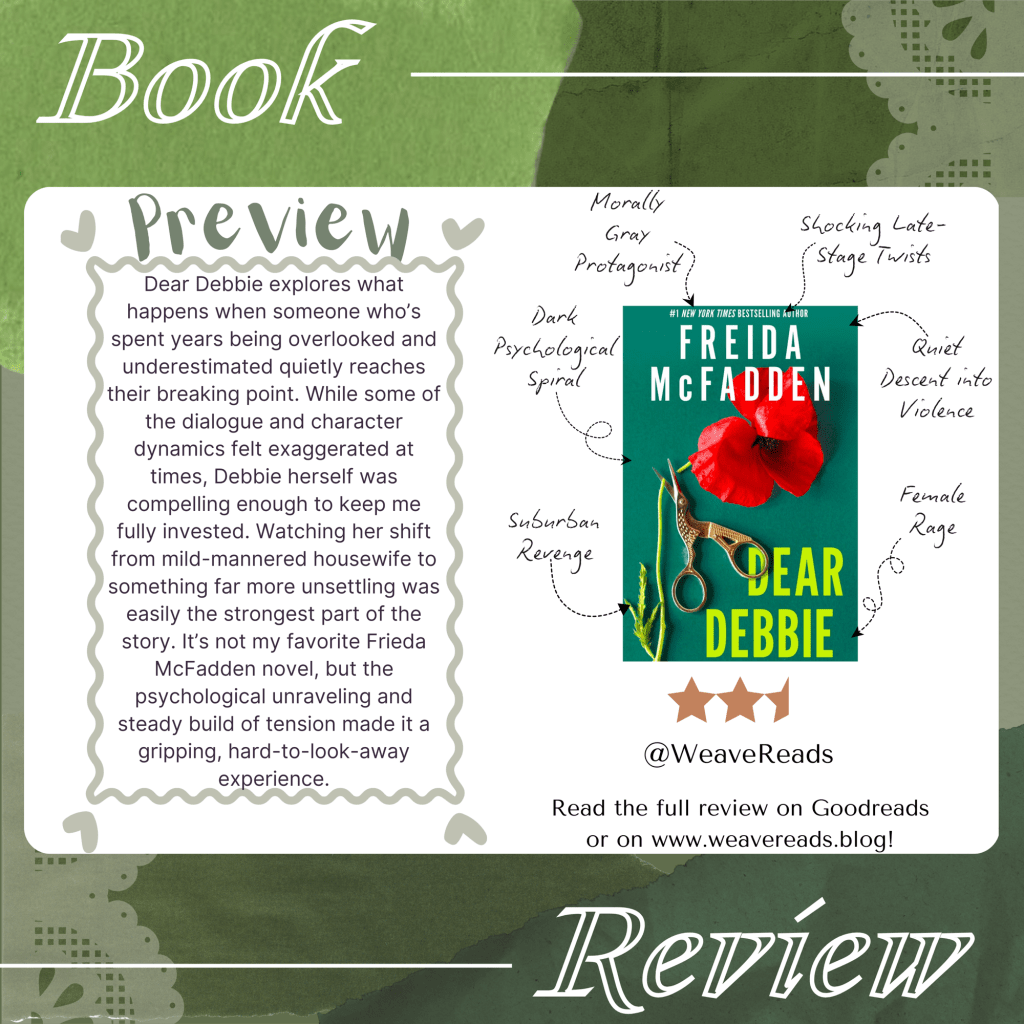
    Overall, “Dear Debbie” kept me engaged the entire time, even when the dialogue felt forced or the characters felt exaggerated. Debbie’s transformation was compelling enough to carry the story. It’s not my favorite Frieda McFadden book, and there were definitely moments where I struggled with the realism and tone, but the twists were effective, and Debbie herself was fascinating to watch unravel.

    2.5 stars, rounded up to 3.

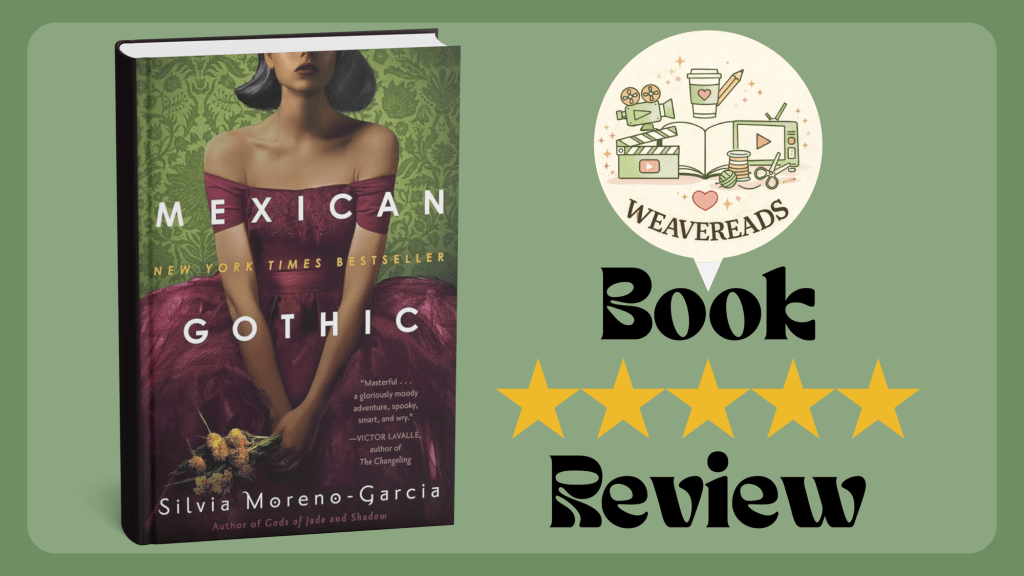
  • Mexican Gothic — Review **SPOILERS**

    Not even ten pages in and I was already hooked. A frantic letter from Catalina about ghosts, voices in the walls, poison in the air? Say less. I was locked in immediately. The dread starts early, and it never really lets up.

    But also: WHYYY would Noemí agree to go visit her obviously possessed cousin in an obviously haunted house??? I know it’s the 1950s and women were expected to obey their fathers and maintain appearances, but the second I heard about High Place I was like absolutely not. That manor is the definition of once-beautiful, now-rotting grandeur. Mold creeping up the walls, decay seeping into everything — you can practically smell it through the pages, and I was not happy to be forced among those walls. (But I was also excited, nervously anticipating every little thing that happened!)

    And the DINNER RULE. No talking at the table?? I would have combusted. The silence, the tension, the scrutiny; I need to yap to survive awkwardness.

    Noemí, though? Kind of a badass. She’s glamorous, sharp, and far more intelligent than the Doyles give her credit for. She pushes back without being reckless, and holds her ground while still playing the polite social game she’s forced into. I loved that about her. She didn’t make the typical kind of horror-movie decisions that make you want to scream at the page.

    The Doyle family dynamics are deeply unsettling. I was a little confused at first about the history — especially once Ruth enters the picture and we learn about the earlier violence — but the confusion almost works in the story’s favor. It mirrors how disorienting High Place feels. Florence is cold and cruel, her son seems sweet and tragically trapped, and Howard Doyle? Absolutely vile. The man talking about “forging a new race” and “superior and inferior types” made my skin crawl.

    And Virgil… Ugh. That’s what makes him scary. He’s convincing. Charming when he wants to be. There were moments where I almost felt bad for hating him; then I’d remember the manipulation, the control, the way he moves through rooms like he owns everyone in them. Every time Noemí left something out of her letters to her father — the sleepwalking, the rash, the escalating creepiness — I was internally screaming “THIS IS THE TIME TO WORRY!”

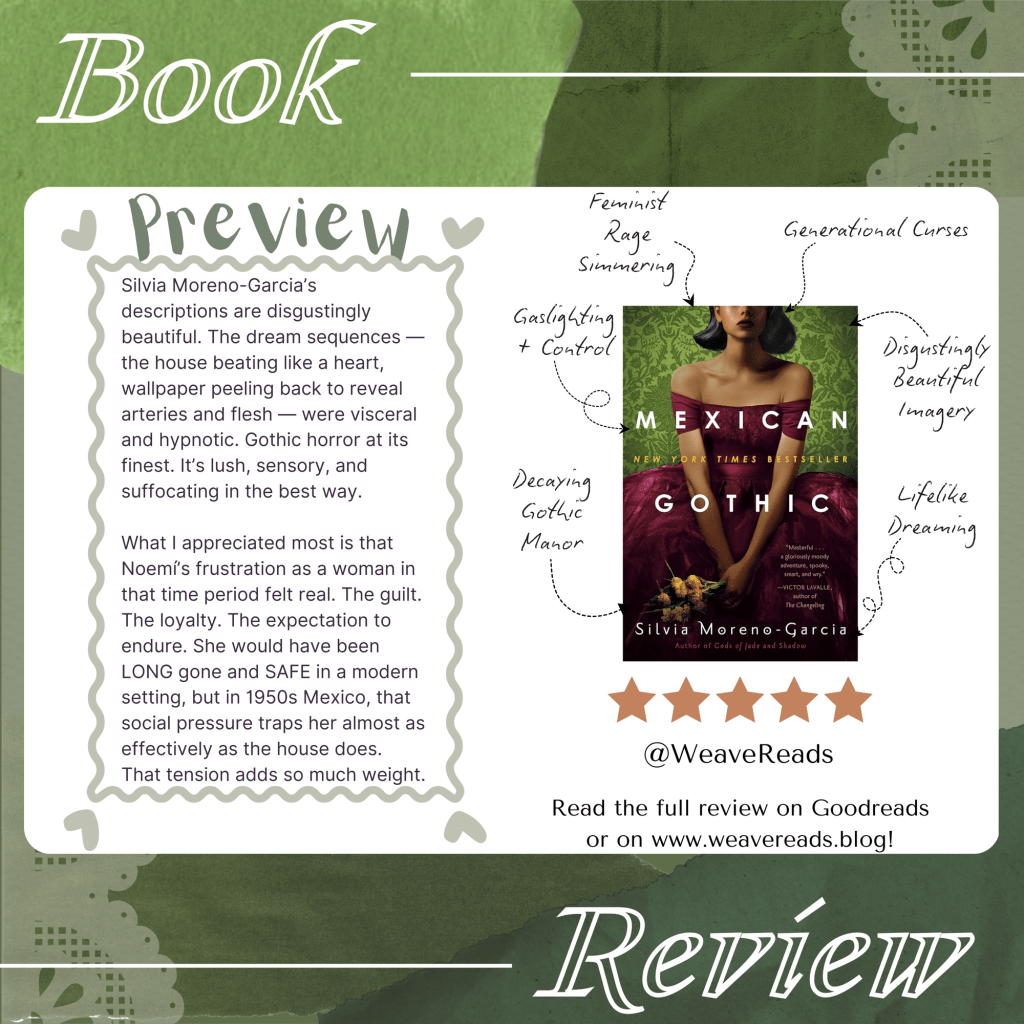
    Silvia Moreno-Garcia’s descriptions are disgustingly beautiful. The dream sequences — the house beating like a heart, wallpaper peeling back to reveal arteries and flesh — were visceral and hypnotic. Gothic horror at its finest. It’s lush, sensory, and suffocating in the best way.

    The deeper the story goes, the darker it gets: the curse, the incest, the generational rot, the way entitlement and colonial arrogance metastasize into something literally monstrous. It’s horrifying not just because it’s supernatural, but because it’s rooted in very real historical ideologies.

    What I appreciated most is that Noemí’s frustration as a woman in that time period felt real. The guilt. The loyalty. The expectation to endure. She would have been LONG gone and SAFE in a modern setting, but in 1950s Mexico, that social pressure traps her almost as effectively as the house does. That tension adds so much weight.

    And somehow, after all that decay and corruption, we get a satisfying ending. Earned. Hopeful. Cathartic. Thank God.

    The premise felt fresh and unique, the atmosphere was thick and immersive, the characters were layered and believable, and the horror was both psychological and grotesque.

    Five stars. I loved it.

  • Book Review — Chasing the Boogeyman

    “Chasing the Boogeyman” was one of those reads where I kept pausing just to sit with how WELL it was working for me.

    Going right into it, I didn’t know how I’d feel about the author’s introduction — those can be hit or miss for me — but I actually really appreciated the insight into Richard Chizmar’s background and what pushed him to write this story. There are a couple of lines in there that have stuck with me, especially the idea that some things in life (and death) aren’t meant to be understood. That sentiment becomes the backbone of the entire book.

    The early town history dump immediately made me think of Stephen King (who’d have thunk?) — from the suspicious fire at The Black Hole (a ramshackle jazz club that absolutely feels like a cousin to The Black Spot from “IT”), to the way childhood, evil, and location are all tied together. And while King tends to weave his history slowly through the narrative, Chizmar lays it out upfront. Normally that would bother me, but here it actually works, especially paired with his explanation that towns have two faces: the public one, and the secret one. Once that clicked, I loved the setup.

    The blend of true crime elements with the narrative is incredibly effective. The factual details, police interrogations, and real-feeling documentation ground everything in a way that constantly made me forget I was reading fiction. The crime scene photos and author-provided images added so much atmosphere; it’s unsettling in the best way, like you’re flipping through a folder of evidence instead of pages in a book.

    I also really loved the sharp tonal shifts between sections: one moment you’re deep in a police investigation, the next you’re drifting through Chizmar’s lush, almost poetic description of a Fourth of July parade. That contrast makes the violence and dread feel even more intrusive, like horror bleeding into moments that should be safe.

    What really got me, though, was the nostalgia. Chizmar captures childhood memories so vividly — the naïve loyalty between friends, the belief that those friendships are forever, that soft, safe warmth that only exists when you don’t know just how dark and cold the world can get. It made the horror hit harder, because I could FEEL what was being threatened.

    There’s a particular line about the killer’s white mask “floating” closer in the darkness that genuinely made me shudder. That single word made the Boogeyman feel less human and more supernatural, otherworldly. Inevitable. Unstoppable.

    And the reveal? My jaw actually dropped. No spoilers, but I truly did not see it coming. Which I suppose was the point; that in keeping it from his limited perspective, Chizmar presented a narrative that was real, emotional, and truly frightening.

    Overall, this felt like true crime amplified: nonfiction textures blended with sensationalized fiction, photos, interviews, and deeply personal reflection. Chizmar didn’t just tell me a story, he dropped me into the town and left me there, forced to watch everything unfold as one of the townspeople.

  • Book Review — Julia **SPOILERS**

    Going into “Julia” with basically zero context other than “it’s a retelling of 1984” (a book I honestly haven’t touched since middle school) probably wasn’t the smartest move, but here we are. I’ll be real: I felt a little slow to the draw at first. It opens with a pretty heavy dump of names, roles, and information, and I spent a chunk of the beginning just trying to orient myself and figure out who was who and why I should care. Once it settled, though, it was ON.

    Because holy sh*t — that moment with the baby. I genuinely did not see that coming. Was it a miscarriage? A purposeful abortion? Some faceless culprit leaving it for Julia to find? That whole sequence completely knocked the wind out of me. From then on, this books became one of those reads where taking notes almost feels pointless because everything is so mentally involving. So much is constantly happening that I just wanted to keep going and find out what fresh horror was waiting on the next page. (And, refreshingly, a different type of horror than I’m used to!)

    The way Julia is interrogated after reporting the baby is infuriating. The immediate suspicion, the way she’s treated as guilty no matter how much she denies involvement — it perfectly captures that “guilty until proven innocent” nightmare of a society. And then somehow… Vicky (the aforementioned culprit) is just fine? Or at least not exiled, silencer, or erased? Even if her protection comes from engaging with someone higher up, the lack of consequences felt bizarre and confusing. The rules of this society are so murky: where is the cutoff for punishment, exactly? Who gets spared and why?

    Julia’s whole arc with O’Brien stressed me out to no end. She keeps getting summoned to meet him and puts it off or delegates, and all I could think was: isn’t that more suspicious than just going and getting it over with? I didn’t fully understand the hesitation beyond his Inner Party status, but everything about him felt suffocating and wrong in a very intentional way. Same with the class dynamics; Julia getting attacked by people lower than the Outer Party and then having to hide it confused me. She’s technically above them, so why is she the one afraid of the consequences? The power structure seems deliberately skewed and disorienting, which I get is the point, but it still left me frustrated.

    Also: the way this book handled women made my blood boil, which again, is very much the point. Even in a society where everyone is oppressed, women are still treated worse. The constant predation. The lack of agency. Winston insisting Julia accompany him places she doesn’t want to go. I just cannot find it in myself to like a single man in this book. Let the women breathe. Let them THRIVE. Vicky wanting to be a nurse and still being surrounded by creep-o men made me want to scream.

    Julia’s skewed understanding of sex and relationships is fascinating and horrifying. Her willingness to treat herself as disposable, to sleep with men in her department as a form of resistance or information-gathering, is such a bleak reflection on what this society has done to her sense of self. I did love seeing Vicky finally speak more freely and call Julia out — especially the moment she points out “we’re they.” That realization hit hard. You can’t blame an abstract enemy when you’re actively participating in the machine. Vicky wanting to go, to leave entirely, felt like one of the few moments of clarity in the whole book.

    The torture scenes were brutal. Like vividly, disturbingly descriptive. Hard to read because I could picture every second of it. And then… They just let her go? Maybe I’m just used to the brutality of “The Handmaid’s Tale,” but that’s where my frustration really peaked. What does this government even want? They torture people for information they already have, threaten to destroy them completely, and release them more-or-less intact. (They do start being considered as “unhumans,” and treated as such.) And Julia being pregnant through all that? There is absolutely no believable world where that pregnancy survives the physical abuse, shock treatments, and sheer stress of it all. Which makes it even more baffling that the book made such a huge deal about Julia specifically being chosen to carry “Big Brother’s” baby. Why choose her just to nearly kill her anyway? The logic completely breaks down for me there. (Though I guess maybe it could be considered the plot’s scapegoat: the only reason Julia was able to make it out alive was because of a visibly worn pregnancy badge.)

    That said, there are moments that absolutely shine. “The feeling was always beneath the surface: a threatening-promising rage that contained the germ of an idea.” Incredible line. And when Julia finally lets herself hate — when we finally get a raging woman instead of a compliant one — it’s deeply satisfying. Harriet’s line perfectly encapsulates my thoughts while reading this: “all men are rotten.”

    The ending reveal with the Free Brotherhood being just another Big Brother was grim but effective. The illusion of choice was one of the strongest themes here; no matter where they turn, allegiance to some higher, controlling power is required. Different name, same overall power-grab. That parallel really struck me, especially with how the initiation mirrors the very system they’re supposedly escaping.

    Overall, “Julia” is a strong, frustrating, disturbing, and thought-provoking read. It made me uncomfortable, confused, and angry — often all at the same time — which I think is exactly what it’s meant to do. While I had a lot of questions and moments of genuine irritation, the narrative itself is powerful and memorable. I’m landing at a solid 3 out of 5 stars.

  • Book Review — Growing Things **SPOILERS**

    Paul Tremblay’s short story anthology “Growing Things” starts strong and immediately reminds me why his writing always takes a second to fully settle into my brain. Seeing as there were 19 stories in this collection, my review will focus on my favorites, but my overall rating is for the book as a whole.

    The title story “Growing Things” is quiet in that deeply unsettling way that Tremblay does so well. In just a few pages, Merry casually mentions that she barely remembers her mother, who ran off when she was four, yet clearly remembers a preacher who had been intermittently in her life around the same time. That detail stuck with me more than anything else. It felt like such a sharp observation about memory and absence; how we assume the people that are supposed to be there will always be there, so we don’t bother etching their memory in our minds until it’s too late. Marjorie, meanwhile, fully embraces the role of unsettling older sister, drifting from eerie to almost comatose in a way that’s genuinely uncomfortable to see unfold.

    I loved the concept here: un unstoppable, unknown force of “growing things” that can punch through manmade structures and and render humanity useless. But I won’t lie, I walked away feeling a little lost. I couldn’t tell if the story was smarter than me or if I just wanted a little more payoff. The ambiguity is intentional, obviously, but it still felt anticlimactic for how strong the premise was.

    “Swim Wants to Know if it’s as Bad as Swim Thinks” surprised me, because I usually don’t vibe with first-person POV in horror (or any genre, really). I don’t like being shoved directly into the situation. But this one works, because it isn’t about immersion — it’s about a mind fracture in real time. The way the narrator’s thoughts loop, diminish, contradict themselves, and rewrite reality is genuinely fascinating. It becomes clear pretty quickly that she did something horrible involving her daughter, lost custody, and isn’t allowed anywhere near her… and the story absolutely dangles that question in front of you like bait. WHAT did she do??? Oh, and apparently there are monsters coming out of the ocean, but that’s… lesser news, somehow. The narrator is deeply unreliable, manipulative, and still somehow calculating despite nearly unraveling, and while the ending twist comes fast, it was worth it. Expected, but effective.

    “Something About Birds” fully sent me into WHAT IS HAPPENING territory. I don’t care how popular or respected Wheatley is, if someone gifted me a bird head, we’d be done. The moment that thing either grew or got replaced by some disturbingly realistic, fleshy bird mask, I was locked in. And then suddenly we’re dealing with what feels like a full-blown bird cult — torture, ritual, sacrifice — possibly all because of a poem? Or because Wheatley initiated something? I have so many unanswered questions, and while that’s kind of the point, it left me spinning.

    “Nineteen Snapshots of Dennisport” might be one of my favorites purely because of its structure. A narrator describing numbered photographs, revealing bits of their life through frozen moments, immediately worked for me. I was fully convinced this was headed toward an affair or a crime-of-passion moment, but the twist caught me off guard (in a good way!) I still wanted more (I always do with short stories), but I loved that it went somewhere darker and colder, especially with the narrator quietly setting up revenge.

    And then there’s “A Haunted House is a Wheel Upon Which Some Are Broken,” which I adored. An interactive story?? Immediate yes. I stopped taking notes because I was having too much fun. The repetition works beautifully here, and by the end, it becomes this really powerful meditation on grief, loss, and the slow painful movement towards acceptance.

    All of the stories orbit similar themes: fractured minds, unreliable narrators, quiet apocalypses, and the monsters we agree to live with. Some landed better than others, some left me frustrated, and a few genuinely impressed me. Overall this ended up being a 3.5-star read for me (rounded up for 4 stars), for being messy, confusing, thought-provoking, and just very Tremblay.

  • Book Review — The Crash

    I hate giving one star reviews, but this book nearly ended up on my DNF list… and I hardly EVER do that! I didn’t take notes while reading — partly because I was flying through it, and partly because I was annoyed — so this review is entirely based on the lingering frustration I’m still experiencing after finishing.

    First of all, the amnesia trope in the beginning. I know trauma can cause memory issues, and being drugged certainly complicates things, but the way it’s used here just feels like a lazy plot device. She forgets everything… Until she suddenly remembers given the slightest nudge? I don’t know; it didn’t surprise me, it didn’t feel earned, and just made the twist land flat — even though the underlying event (her assault) is genuinely awful.

    And then there’s Jackson. Absolutely not. The second I found out who he worked for and what he’s been covering up, he would have been dead to me. This book tries so hard to swing him into a redemption arc, like we’re supposed to root for them to end up together, or feel conflicted about his behavior. Nope! He swept Simon’s crimes under the rug for years. Even after he “comes to his senses,” he’s still using hidden crimes as leverage for Tegan’s child support? What else has he buried that we’ll never find out? I don’t care what the narrative was trying to convince me of. Jackson sucks, and I’ll die on that hill.

    Speaking of questionable characters: TEGAN NEVER TELLS THE POLICE SHE WAS HELD CAPTIVE FOR FOUR DAYS. W H A T????? Just because Polly saved her in the hospital, and Hank saved her from the initial car crash, does not erase the basement imprisonment! One good deed does not a good person make. And now Polly and Hank are foster parents barely a year later?? I feel for and sympathize with a couples’ infertility issues, I truly do. But almost killing someone and stealing their baby requires more than just waking up one day and realizing “Oh, maybe I went a little crazy there.” She should be in a hospital at the very least getting some mental help, and Hank should be arrested as an accomplice.

    As a main character, Tegan was also really hard to root for. She has no survival instincts, she gives up the second things get inconvenient, and the victim mentality never lets up. One specific part at the end stands out to me the most: she spends the majority of the story repeating like a mantra that she has no family left, her brother is the only one in her life she can trust, yadda yadda. So that’s supposed to make it that much more heartbreaking and surprising when he tries to kill her in the hospital. But she also makes a comment while in the hospital that her room is FILLED with gifts and flowers from everyone in her life. It sounds like she has quite a bit more support than she let on. I wanted to care, I really did. But by the end I was more so rooting for the book to end, not for her to escape.

    All that said, this is just proof that Frieda McFadden is not the author for me. And that’s totally fine! I’d categorize this as “flight reading”: if I were stuck somewhere for several hours with nothing else, this would keep me awake. Barely.

  • Book Review — IT

    Finishing IT feels like such a personal victory that I’m still kind of floating 24 hours later (haha get it?) I didn’t take notes while reading (like I usually do) partly because I  wanted to let it break my slump naturally, and partly because I’ve hyped this book up to myself for years and I wanted the experience to go smoothly. I took my time, I really lived in Derry while reading it, and even now I feel like I can close my eyes and sketch a map of the town from memory. King’s world-building is unreal; he makes you feel like knowing the pharmacist’s mother’s maiden name is important, like the sidewalks and Barrens are places you’ve walked your whole life.

    And somewhere in the middle of cosmic, otherworldly horror… Richie Tozier snatched my heart and refused to give it back. There’s just something about him in the book that hits so much harder than any adaptation. He’s loud and annoying and funny and loyal in a way that feels heartbreakingly human. Finn Wolfhard honestly did a phenomenal job capturing that chaotic sweetness — frankly more on the chaotic side, let’s be real — his Richie is probably the closest anyone has gotten to the version living in my head.

    One of the biggest surprises, though, was how deeply the Losers love Bill. The movies don’t portray it half as intensely. In the book, their loyalty to him is bone-deep and completely unquestioning. There was an instant understanding that he was their leader intended to take them to victory, or die trying. Eddie literally thinks about dying for him without hesitation (RIP Kaspbrak). None of them doubt his leadership, not even 27 years later when they’ve forgotten almost everything else. It’s such a beautiful, innocent kind of reverence that only childhood friendships can produce, and reading it genuinely made my heart swell. (This is also one of the only books where I highlighted my favorite quotes.)

    Speaking of beautiful: Ben and Beverly. I was not prepared for how soft and sincere Ben’s love would be on the page. It’s not obsessive or dramatic; it’s patient, understanding, accepting, and lifelong. He admires her bravery, he loves her without expecting anything from her, and somehow that persistence feels more romantic than any grand gesture could. It’s sweet in the way in childhood crushes are sweet, but also enduring in a way adult love rarely is.

    And then there are the moments where I’m reminded why King is the King — namely the part where Richie and Mike have their vision during the Ritual of Chüd, where they witness the Coming of It. The scale of it, the mythology, that mix of cosmic dread and awe… I genuinely got chills. King has this talent for taking something that shouldn’t be scary, and making it terrifying by the end.

    The thing that surprised me most, though, was how nostalgic it made me. Not just for childhood, but for the intensity of childhood friendship, the way those bonds feel fateful and never-ending. The Losers are tied together in a way that feels like spiritual, like destiny, and King writes their connection so well that I genuinely missed being a kid while reading.

    I’ve watched the movies for as long as I can remember — Tim Curry’s Pennywise was practically a family member in my childhood home — so reading the book felt like stepping into the “real” version of a story I’ve loved my whole life. I do wish I had taken the time to tab things or jot notes down so I could have done a real, polished review, but honestly? It just gives me even more of a reason to reread it. And if even one person tells me to do a dissertation-level breakdown comparing the miniseries, the Skarsgård movies, and the book, I will absolutely do it, Powerpoint and all.

    For now though, finishing IT feels like a major Reading Bucket List item that I’ve just ticked off. I’m proud of myself, I’m out of my slump, and now I can finally get back into my ever-growing TBR list.